by Christine Lorraine Morgan ~ Dec. 22, 2025
Bonjour!
Here’s another dose of Erie’s “Forgotten History” regarding some of the area’s first non-indigenous settlers (French) who lived near the mouth of Mill Creek in the 1750s:
“Presque Isle fort and road, (which run south on the line of Parade Street), were completed August 3, 1753. The fort was 120 feet long, two stories high, with a log house in each corner, and gates at the north and south sides, and built of chestnut logs, on the west bank of Mill creek something over 100 yards from its mouth, adjoining the ground now occupied by the Soldiers’ and Sailors’ Home,” states the 1888 book Erie, Penna. Illustrated.
It appears as though the ruins of Fort Presque Isle were a playground for youngsters growing up in Erie during the 19th century.
“The ruins of this fortification were plainly visible 25 years ago (in 1853), and citizens of the city who played around there in boyhood and who are still young men, are able to identify from memory almost the exact location described in history.
“The stone foundations of this fort were removed in June 1888 by Messrs. Paradine & McCarty, whose brick-yard is located near by; 20 musket barrels, bayonets, etc., were found in the north end. The foundation was three feet deep and the original hard clay floor was covered with ashes, under three feet of clay.
“There was at this period a French village of more than 100 families, a grist mill, a Catholic priest and a school master, on the east bank of Mill creek. They cleared land and cultivated cornfields. The village appears to have been abandoned after a few years’ experiment, as it was not in existence in 1758.
“The abandonment of this village may be attributed to smallpox, which appeared there about 1756.”
Wonder what would have happened if that French village had not been wiped out from the repercussions of small pox? Would we be speaking French now here in NW PA?
Je ne sais pas. 
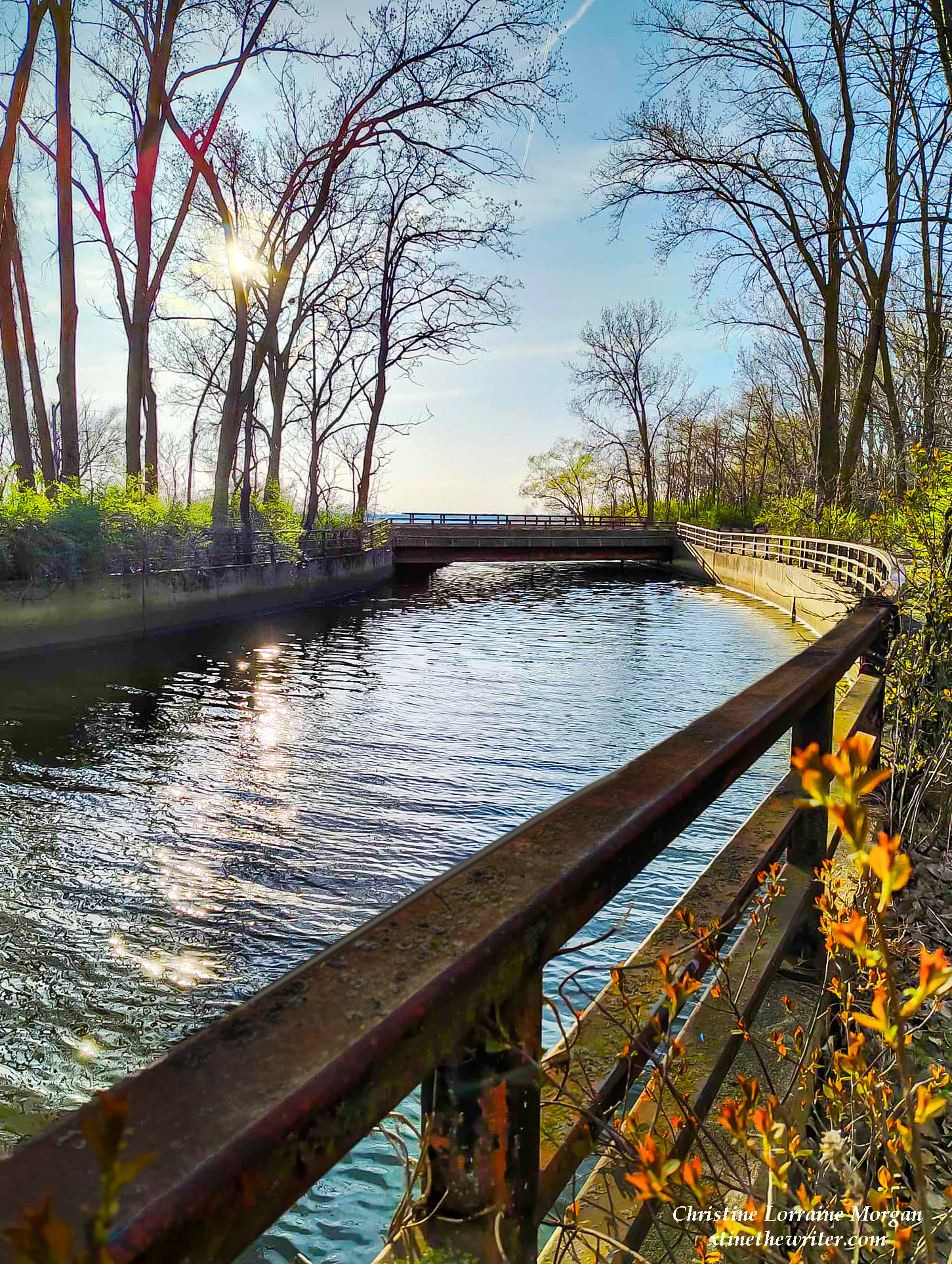
This image shows the mouth of Mill Creek off of Oredock Road in 2025, where so much of Erie’s history originates.


 xtinethewriter.com ~ Where Creativity Lives in Words and Pictures