
by Christine Lorraine Morgan, April 7, 2026 with research material from GC68/Toby
In Erie’s southeast corner, there stood a column of gravel in the mid-20th century, which was all that was left of a sloping knoll from centuries past. It sat between the SE corner of Erie and the Philadelphia and Erie Railroad. It was a sprawling native American burial ground, where artifacts and skeletons from the Erie Nation were unearthed.
The area was variously referred to as the Downing property, Schouler’s Woods, and the First P. and E. woods. It was said to be just a small portion of an extensive gravel stretch that once reached across the southeastern edge of Erie.
“For nearly a century an incalculable number of Indian burials have been periodically unearthed here as sections of the ridge were cut away for gravel,” cites the 1949 “Pennsylvania Archaeologist.” This reference book refers to this burial ground as the “East 28th Street Site.”
Records indicate in about 1900 the discovery of “3 pipes, a bearclaw necklace, the lock from a flintlock gun, blue and red glass trade beads, copper beads an inch in length, a strip of silver 1″ x 1/2″ and 12-15 triangular arrowheads,” by Captain MacGraw around this “wooded knoll” in Schouler’s Woods.
Prior to that, a “large skeleton with two copper bowls perforated at the edges and laced together with a buckskin thong, which fell to dust soon after being exposed to the air,” were found in that same area, according to the PA Archaeologist. The bowls would have held around 32 ounces each, and were filled with beads when unearthed.
By 1937, 24 graves had been excavated from this site. They held the skeletons of around 30 children and adults. Details of these remains were documented.
“It should be kept in mind, however, that this by no means represents the total number of graves in the cemetery, for there is ample evidence attesting the destruction of skeletons in earlier years.”
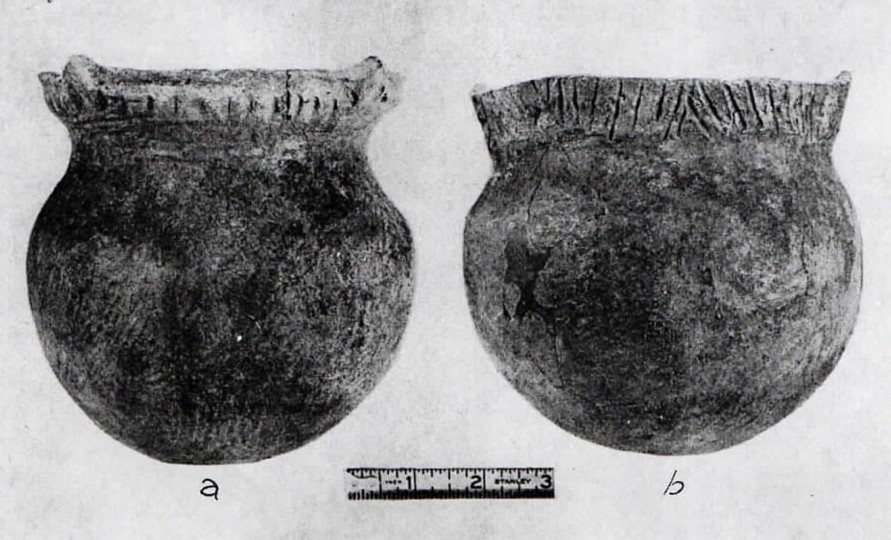
Among other artifacts, 13 pottery vessels were discovered at the E. 28th Street site which were identified as being from the Eries who dwelled here. The vessels were said to be from the 1630 to 1645 time period.
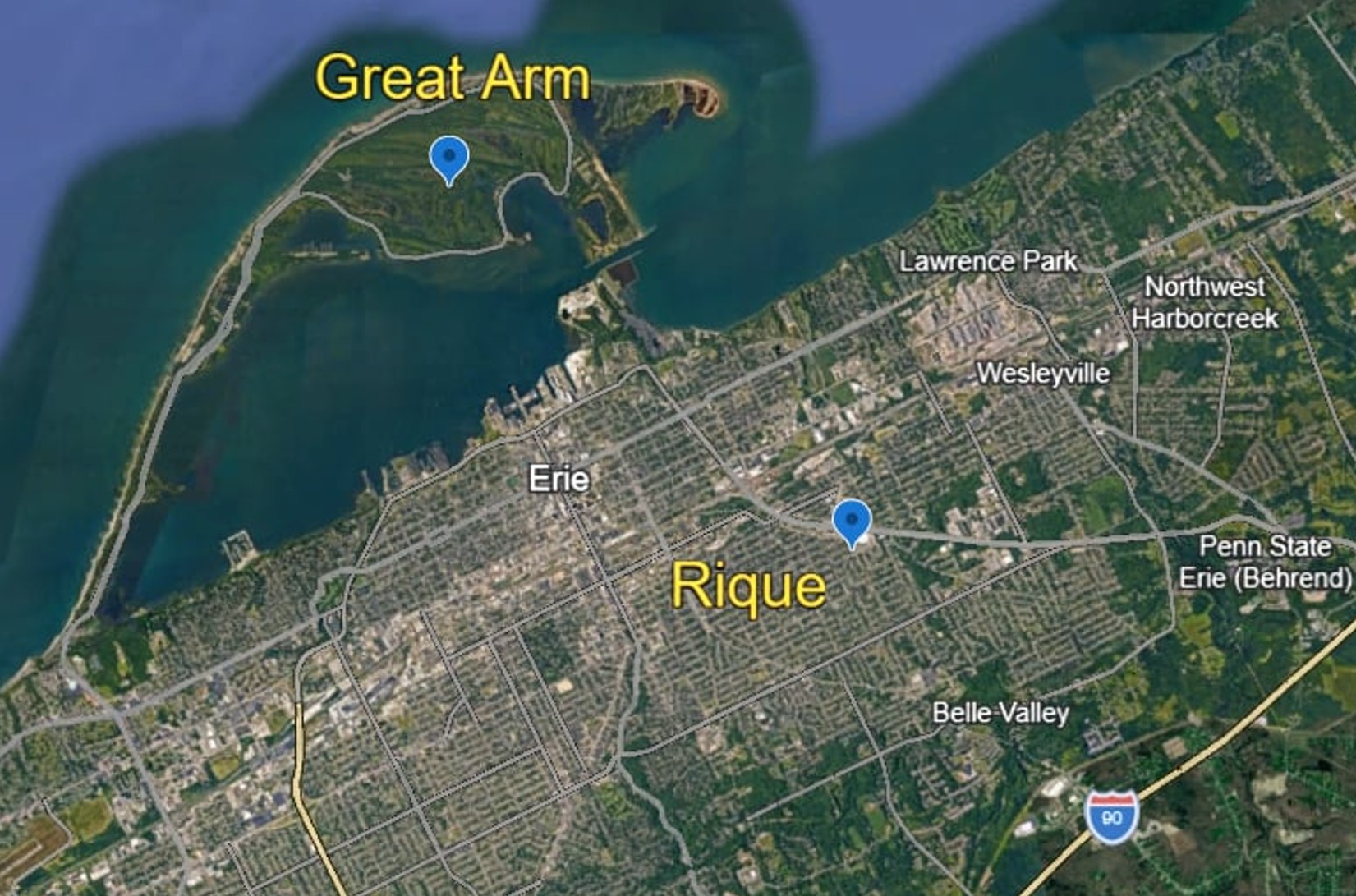
“…Somewhere in the immediate area stood the palisaded Erie town of Rique, repeatedly referred to by the Jesuits as the Erie capital and destroyed by the Seneca in 1656,” the archaeology publication continued.
Also excavated were four pipes; two were a “ringed bowl” style of earthenware, the other two were made of stone. One of the stone pipes was the head of a pig, and was delicately whittled from a “soft, creamy” stone. The other was a simple limestone piece or “talc-like” stone with two holes of a cone shape that contained no decorative elements.
Scientists were able to assign the mid 1600s date to these graves because various date-able relics which came from Europe were also removed from the dig site, including axes, bracelets, knife blades, and rings of iron. European brass and copper pieces, and thousands of trade beads were also recovered.
A lengthy list of native remnants were recorded from this excavation area.
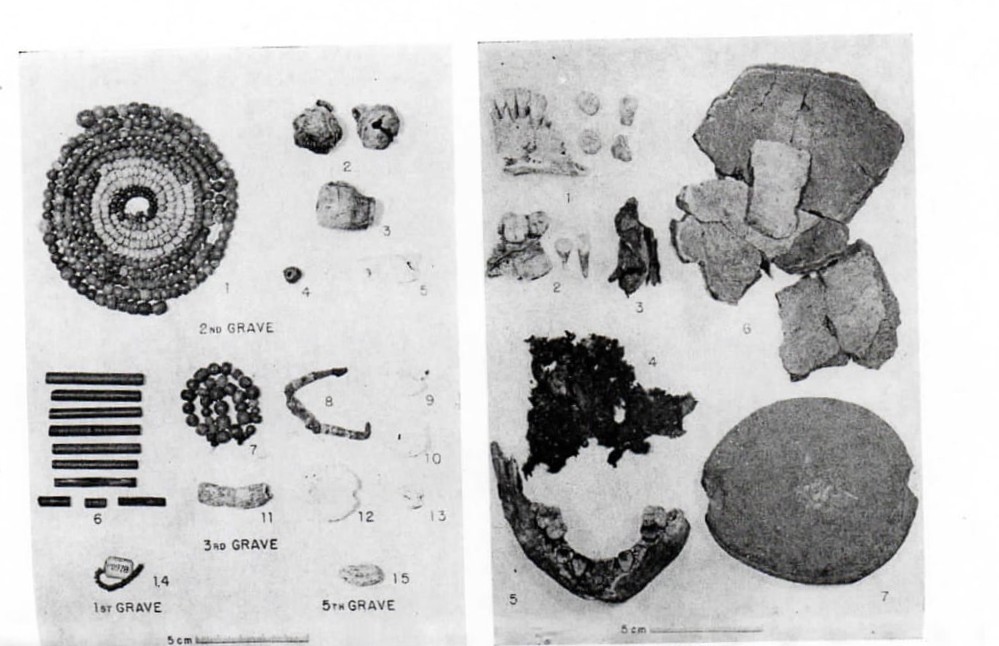
Native pieces that were found included 17 shell ornaments, 12 beads in various shapes with two made from the columella, and a small triangular catlinite bead cross-section.
Segments of fur and buckskin, finely woven basketry, shrouds of bark, and fragments of what might have been a beaver pouch and a woven blanket were recovered. Additionally, a turtle shell cup and a couple of blue pottery clay lumps were discovered with “bone implements.”
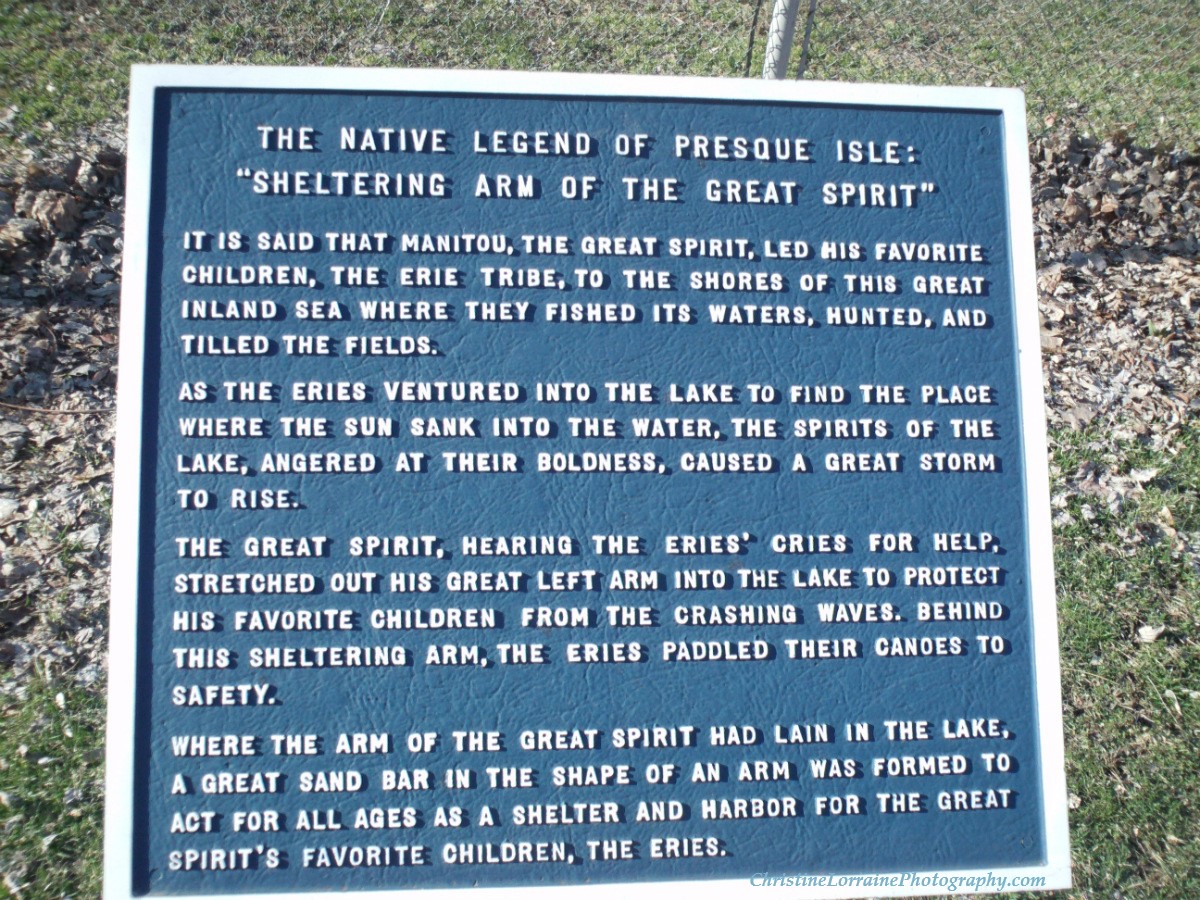
To conclude this piece about the Erie Nation, which was eradicated in the mid 1600s, here is a historical marker that explains the Eries’ story about Presque Isle, which they perceived as the Great Arm. Here’s why:
This fabricated map shows the close proximity of Rique to the “Great Arm.”
Images are from 1949 Pennsylvania Archaeologist showing some of the East 28th Street excavation site recoveries.


 xtinethewriter.com ~ Where Creativity Lives in Words and Pictures